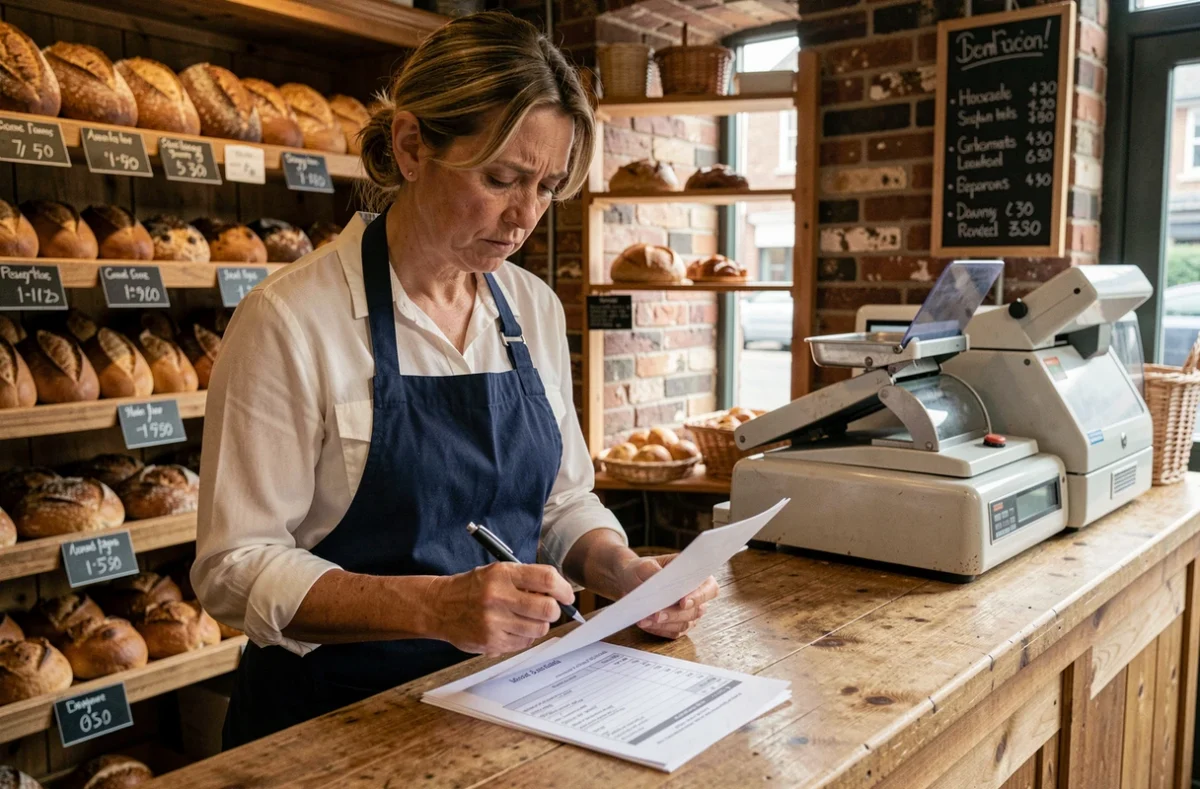
A café owner in Birmingham renews a business energy contract and finds the unit rate has jumped by a third since the last deal. The same week, food supplier invoices land showing only modest movement. These two line items sit inside the same inflation figure, but they hit the P&L in completely different ways. Understanding which costs are actually rising, and which ones a small firm can renegotiate, matters far more than tracking the headline CPI number alone.
How UK CPI breaks down for a small firm’s cost mix
CPI reached 3.6% in the year to October 2026, up from 3.5% in September. That single figure hides a split worth examining: goods inflation rose to 3.5%, while services inflation held steady at 3.7%.
You may also like: UK Budget 2026: what the latest tax changes mean for businesses
For a small business, those two categories map onto very different budget lines. A retailer sourcing physical products faces rising goods costs. A consultancy paying for software licences, accountancy fees and office cleaning sits on the services side. A hospitality business straddles both, buying food (goods) and paying for waste collection or equipment maintenance (services).

You may also like: Bank of England interest rates: the latest outlook for UK businesses
Food-price inflation, meanwhile, actually eased to 0.9% in October 2026, down from 1.3% in September. That is a concrete relief for restaurants, cafés and food retailers, even though the overall CPI ticked upward. The lesson: headline inflation rarely matches a specific firm’s cost exposure. A bakery and a logistics company experience the same CPI month in entirely different ways.
Energy costs, payroll and food: which lines can a small business renegotiate?
Take the example of a small café. Its three largest variable costs are typically food inputs, payroll and energy. Each of these behaves differently under inflation, and each offers a different degree of negotiating room.
Food inputs
With food-price inflation at 0.9%, ingredient costs are rising more slowly than the general price level. Switching suppliers, reducing menu complexity or adjusting portion design can further contain this line. Food is the cost category where small firms retain the most leverage, because alternative suppliers exist and contracts tend to be short or informal.
Payroll and the minimum wage increase
The national living wage is set to rise to £12.21 an hour, a 3.9% increase. For labour-intensive businesses (hospitality, retail, care), this is not a line that can be negotiated away. It is a fixed regulatory step-change.
The concern among employers goes beyond the hourly rate. The combined effect of the wage rise, higher employer National Insurance contributions and other employment costs compresses margins on multiple fronts at once. A café employing five part-time staff will feel this more acutely than a two-person consultancy.
Business energy contracts
Ofgem’s price cap applies to domestic customers, not business tariffs. Small firms negotiate energy contracts individually, and the smallest businesses can face higher unit prices than larger users. There is no regulatory safety net equivalent to the household cap.
This makes energy the most volatile and least predictable of the three main cost lines. A business locked into a favourable fixed deal is insulated. One coming off contract faces whatever the wholesale market dictates. Timing your energy contract renewal is a margin decision, not an admin task.
- Food costs: rising slowly, multiple suppliers available, contracts are short, negotiating power is relatively high.
- Payroll: set by regulation, cannot be renegotiated, absorb or restructure hours.
- Energy: contract-dependent, no price cap for businesses, compare brokers well before renewal dates.
Passing rising costs to customers: pricing thresholds for SMEs
The instinct when costs climb is to raise prices. For large brands with loyal customer bases, that often works. For a small business competing locally, the calculation is tighter.
Raising prices by 5% when a competitor holds steady can shift footfall quickly. The question is not whether to pass costs on but which costs justify a visible price increase and which should be absorbed through operational changes.
A food-led business facing only 0.9% food inflation probably cannot justify a menu-wide price rise on ingredient grounds alone. If the real pressure is energy or payroll, the honest move is to explain that, or to absorb it through efficiency gains: shorter opening hours, reduced waste, simplified menus.
Price rises that reflect genuine cost pressure tend to stick. Blanket percentage increases without a clear driver risk losing customers who compare prices on a per-item basis.
Business energy and employer costs: planning for contract renewals in 2027
Two dates matter more than the monthly CPI release for most small firms: the energy contract renewal date and the start of the new minimum wage rate in April.
For energy, the practical step is to begin comparing tariffs at least three months before a contract expires. Business energy is not regulated by the domestic price cap, so there is no automatic protection if wholesale prices spike close to renewal. Brokers and comparison services exist, but reading the unit rate and standing charge separately avoids misleading headline quotes.
For payroll, the April wage increase is already published. Model the wage bill impact now rather than reacting in March. If the combined cost of the wage rise and higher employer National Insurance tips a role into unprofitability, it is better to restructure hours or tasks before the new rate takes effect.
- Check the exact expiry date of your current energy contract and set a reminder 90 days before.
- Request at least three business energy quotes, comparing unit rates and standing charges separately.
- Run a payroll forecast using the £12.21 rate and updated employer NI to see the full annual cost per employee.
- Identify which roles or shifts become loss-making under the new cost base and decide whether to restructure before April.

What the inflation split means for small business planning
Goods at 3.5%, services at 3.7%, food below 1%. These are not abstract statistics. They translate directly into whether a particular firm’s margins are expanding, compressing or holding steady.
A service-based SME with low physical inventory may find that inflation barely registers in direct costs, but hits through wage pressure and professional fees. A product-based retailer importing goods priced in dollars faces a different equation entirely, one driven by exchange rates as much as domestic CPI.
The firms that manage inflation best are those that know their own cost mix in detail, line by line, contract by contract. Tracking CPI is useful context. Tracking your own input costs, renewal dates and payroll obligations is what actually protects the margin.
October 2026’s CPI figure told us inflation is edging higher. What it did not tell any individual business is whether their costs went up, by how much, or what they can do about it. That answer sits in the accounts, not the news.